


























Views
Downloads

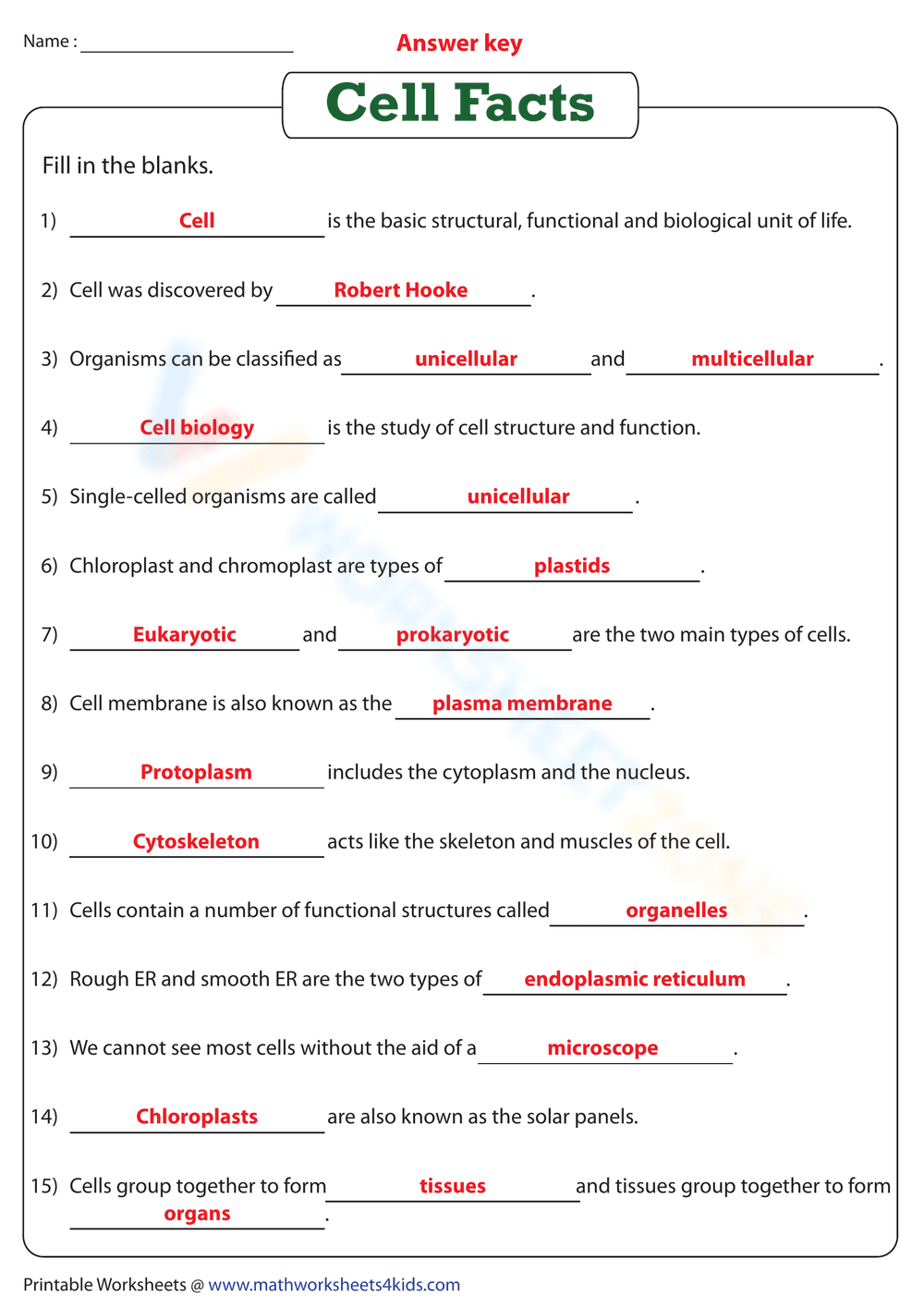

Essential Cell Facts Worksheet | Grade 7-8 Biology
Paste this activity's link or code into your existing LMS (Google Classroom, Canvas, Teams, Schoology, Moodle, etc.).
Students can open and work on the activity right away, with no student login required.
You'll still be able to track student progress and results from your teacher account.
This Essential Cell Facts worksheet provides middle school students with 15 targeted retrieval prompts to reinforce foundational biology concepts. By identifying key terms related to cell structure, history, and classification, learners solidify their understanding of the basic unit of life. This resource ensures students can accurately distinguish between prokaryotic and eukaryotic organisms while mastering complex organelle vocabulary.
At a Glance
- Grade: 7-8 · Subject: Living Things
- Standard:
MS-LS1-1— Provide evidence that living things are made of cells and distinguish between types- Skill Focus: Cell biology and structure
- Format: 1 page · 15 problems · Answer key included · PDF
- Best For: Quick review or sub plans
- Time: 15–20 minutes
Inside this resource, you will find a cleanly formatted one-page worksheet featuring 15 fill-in-the-blank sentences. The content covers essential milestones like Robert Hooke's discovery, the classification of unicellular and multicellular organisms, and the specific functions of organelles such as chloroplasts and the endoplasmic reticulum. A comprehensive answer key is included to facilitate rapid grading or student self-correction.
The zero-prep workflow for this resource is designed for maximum efficiency in a busy classroom. First, printing takes less than 30 seconds due to the high-contrast, photocopy-friendly layout. Second, distribution requires only 1 minute as the instructions are self-explanatory, allowing students to begin work immediately. Finally, reviewing the answers takes approximately 5 minutes using the included key. Total teacher preparation time is under 2 minutes, making it an ideal choice for emergency sub plans or bell-ringers.
This worksheet is strictly aligned to the MS-LS1-1 standard, which requires students to conduct investigations or analyze data to provide evidence that living things are made of cells. By mastering the facts presented here, students build the prerequisite knowledge to describe how one cell or many different numbers and types of cells make up an organism. This standard code can be copied directly into lesson plans, IEP goals, or district curriculum mapping tools.
To maximize the instructional impact, use this worksheet as a formative assessment after an introductory lecture on cell theory. As students work independently, circulate the room to observe if they can correctly identify the difference between plant-specific plastids and general cellular structures. This activity typically takes 15 to 20 minutes to complete and serves as an excellent lead-in to a microscopy lab where students observe actual specimens.
This resource is specifically tailored for Grade 7 and Grade 8 science students who are beginning their study of life science. It is particularly helpful for English Language Learners who benefit from the sentence-frame structure of fill-in-the-blank tasks. For a complete lesson, pair this worksheet with a cell diagram anchor chart or a short reading passage on the history of biology.
Research by Fisher & Frey (2014) emphasizes the importance of retrieval practice through structured fill-in-the-blank activities to solidify domain-specific vocabulary in the middle school science classroom. This worksheet aligns with MS-LS1-1 by requiring students to recall and apply essential facts regarding cell discovery, classification, and organelles. By providing 15 targeted prompts, the resource facilitates a cognitive bridge between broad biological concepts and specific terminology like prokaryotic and eukaryotic structures. Such practice is critical for students to master the foundational understanding that all living things are composed of cells, a core requirement of the Next Generation Science Standards. The inclusion of an answer key ensures immediate feedback, which is a key component of effective formative assessment in science education. Students who engage with these cell facts build the necessary schema to tackle more complex investigations into cellular processes and system-level interactions in later grades.


